 Most reviewed
Guides
Language
EnglishCurrency
US dollar · $GetYourGuide shows prices in the currency you choose.
Guide · The dolphins
The Port Stephens dolphins, the bay's year-round residents
The Port Stephens dolphins do not migrate past the bay: they live in it. Here is what researchers have learned about them, how boats change their day, and how to watch them well.
Check availabilityfrom $33 · cancel for free
Editorial team, dolphincruiseportstephens.comUpdated October 24, 2026Reading time 6 min30 sources
Quick answer
A population that stays
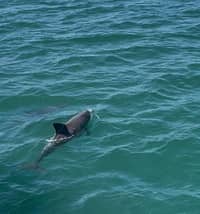
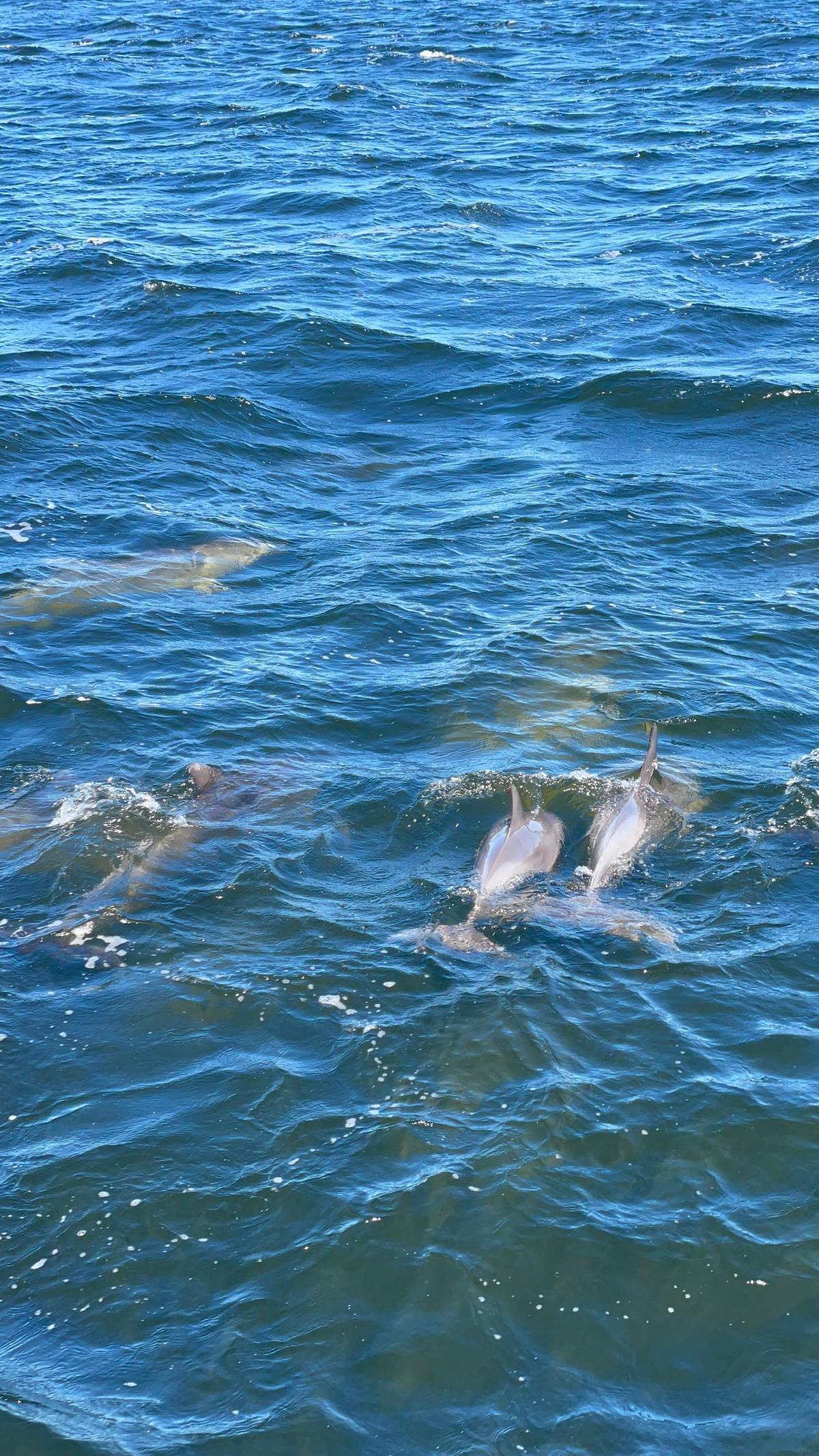
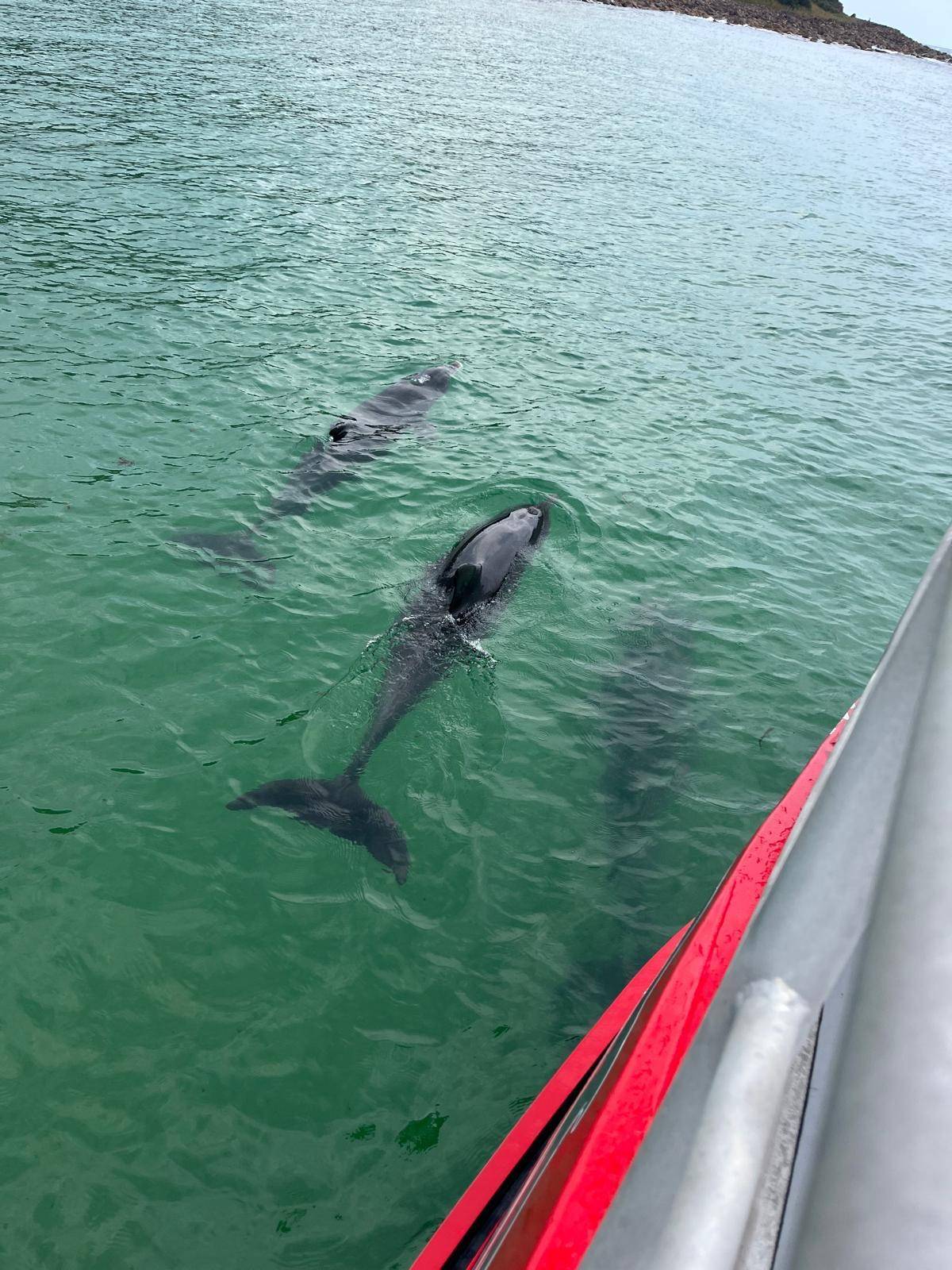
Most marine animals you hear about on the NSW coast are passing through. The Port Stephens dolphins are different: the NSW Government says around 90 to 120 Indo-Pacific bottlenose dolphins live permanently in the waters of Port Stephens, inside the Port Stephens - Great Lakes Marine Park.1 Destination NSW puts it at more than 100.3 Whatever the exact count, these are local animals, born, raised and feeding in the same bay you cruise across.
Science backs up how special they are. Researchers describe them as a small, genetically distinct population of Indo-Pacific bottlenose dolphins, the target of the largest dolphin-watching industry in Australia, in a marine park created in 2005.2 Genetic work across the NSW coast found that more dolphins leave Port Stephens than arrive, which suggests the residents may form social barriers to dispersal.7
For the Worimi people the dolphins have always been more than wildlife. In the Gathang language they are called guparr, and the NSW Government records that elders traditionally spoke with dolphins about food resources and looking after each other.8 It is a good thing to remember when a fin breaks the surface beside the boat: you are a guest in a very old relationship.
A dolphin's life
From calf to adult, bottlenose style
-
Before birth
A year of gestation
Calves are born after about one year.9
-
First months
Suckling
About 6 months by the NSW factsheet, 18 by the Australian Museum.1011
-
Childhood
With its mother
A calf stays with her for about 4 years.10
-
Around 10
Adulthood
Sexual maturity at around 10 years.9
-
Old age
A long life
Two communities in one bay
Port Stephens is a big, drowned river valley with an estuary area of 134.4 km2 and an average depth of 14.1 m, joined to the ocean by a large, deep entrance.1213 Its dolphins have divided it between them. A study of 120 regularly sighted animals, followed by photo identification over 7 years, found two mixed-sex communities.1415
The larger eastern community lives in a typically marine environment near the heads, while the western community ranges over a bigger area shaped by the estuary further up the bay.15 Within each, dolphins mix and part in smaller groups that change from day to day. So the dolphins you meet in the morning may not be the ones another boat met at lunch.
Researchers tell individuals apart by their dorsal fins. Each bottlenose dolphin has a fin with its own shape and pattern of notches and scars.16 Look closely at your photos afterwards: a nick on the trailing edge or a pale scar is how scientists recognise the same animal year after year, and it can be how you recognise a dolphin you have met before.
Month by month
Daylight and wet days at the entrance to the bay
Hours without sunDays with precipitationSeason
The research
How dolphin behaviour changed with boats nearby
| Behaviour | With boats present | Study |
|---|---|---|
| Feeding | 66.5% less time | 2008 to 2009 |
| Socialising | 44.2% less time | 2008 to 2009 |
| Milling | Four times more | 2008 to 2009 |
| Resting | Never seen | 2008 to 2009 |
Surveys from August 2008 to August 2009 in Port Stephens, published in the Journal of Environmental Management.17
Where to meet them
Cruise, sail or a headland?
Most reviewed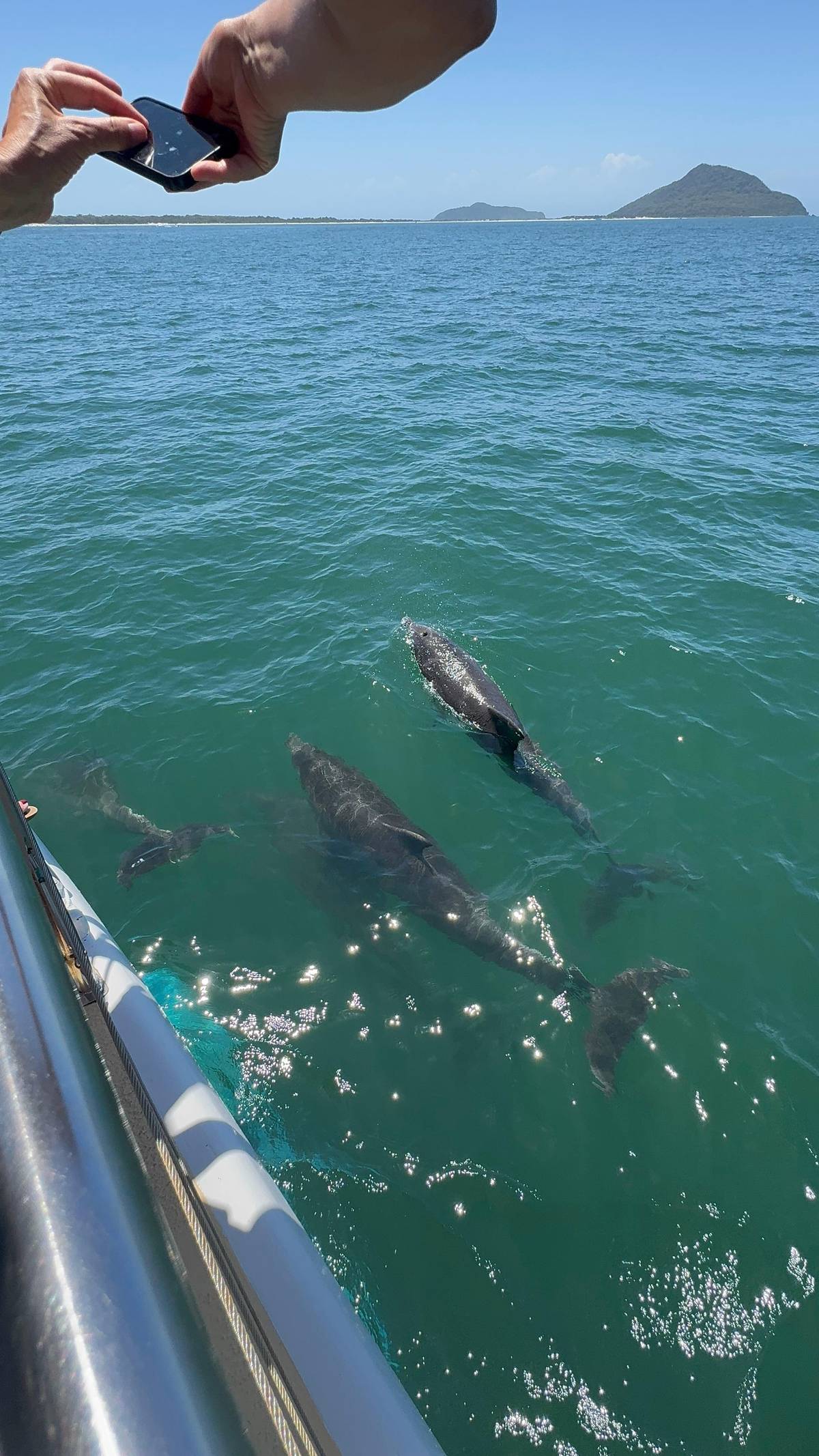 Under sail
Sailing catamaran
From the d'Albora marina
- Duration
- 1.5 hrs
- Rating
- 4.77
- Reviews
- 105
- Price
- from $35
 Top rated
Decision helper
How do you want to meet the dolphins?
Choose what matters most to you
Worimi people are spiritually connected to dolphins, or guparr, as they are called in the Gathang language. Traditionally elders would speak with dolphins about food resources and looking after each other.
What boats do to a dolphin's day
Watching wildlife always changes it a little, and here that has been measured. In surveys from August 2008 to August 2009, dolphins spent 66.5% less time feeding and 44.2% less time socialising when dolphin-watching boats were present, spent four times more time milling, and were never seen resting.17 Groups also pulled closer together and tended to avoid the tour boats, more so as boat numbers rose and distances fell.21
The same study counted how often groups were approached: three times a day in winter and six times a day in summer, and groups with newborns were approached closer than the state minimum in nine of ten encounters.22 The authors suggested no more than one watching boat within 50 m of a group, or 100 m with calves, and fewer boats after 1pm, the dolphins' preferred feeding time.20
None of this means you should stay ashore. It means the way a cruise behaves matters. A skipper who waits rather than chases, who leaves a group that is busy feeding, and who keeps the engine slow is giving the dolphins back some of their day. Ask about it before you book, and notice it on board. A good crew will also explain what the dolphins are doing, whether a group is travelling, feeding or simply milling, and that commentary turns a few minutes of fins into a story you understand.
Checklist
Watching dolphins the right way
01
Do
- Let the dolphins choose how close they come
- Photograph the fins: each one is different
- Bring a hat and sunscreen for the deck
02
Never
- Feed or touch a dolphin
- Swim up to a dolphin
- Chase a group with calves
Cost calculator
What a dolphin cruise costs your group
Starting totals for each dolphin cruise by group size.
People
Total from$65
per traveler from $33
Check availabilityfree cancellationEach total multiplies the lowest per-person starting price on GetYourGuide by the size of your group and converts it at the European Central Bank's daily rate; your date and option set the final amount.
Video
Bottlenose Dolphins Free in the Wild at Port Stephens
The YouTube player stays switched off here until you press play.
The NSW rules around dolphins
New South Wales writes the rules down. A vessel is in the caution zone within 150 metres of a dolphin and may come no closer than 50 metres.4 If a calf is present, a boat may not enter the caution zone for closer viewing at all, and it may not approach from behind or wait in the animals' path.23 Only 3 vessels may share the caution zone at once.24
When dolphins choose to ride the bow wave, the boat must hold its course and speed.24 That is the moment many people hope for, and it is the dolphins' decision, not the skipper's. Jet skis must stay at least 300 metres away, and anyone must keep 500 metres from a dolphin that is mostly white in colour.2526
In the water the distances are shorter but firm. Swimmers, snorkellers and divers may enter the water no closer than 50 metres from a dolphin and must stay at least 30 metres away.5 The NSW Government also asks you not to touch dolphins or encourage them closer, and feeding them is harmful and illegal.276 The rules rest on the Biodiversity Conservation Regulation 2017.28
The dolphin watching season in Port Stephens
Because the dolphins live in the bay, there is no closed season. Destination NSW notes that dolphin watching cruises leave the marina in Nelson Bay all year round.3 The dolphin watching season in Port Stephens is really a question of which conditions you prefer, not whether the animals are there.
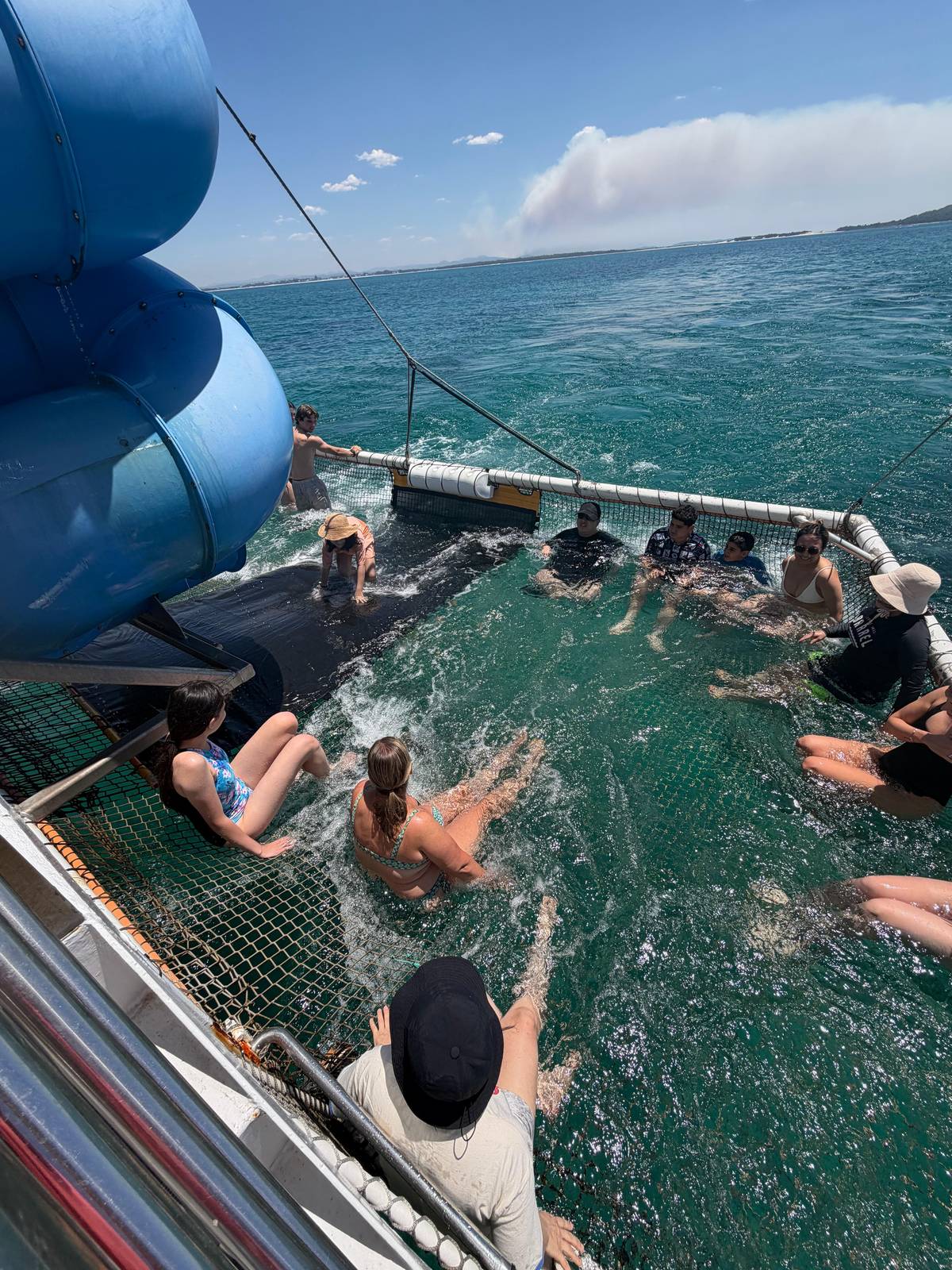
Summer brings warm days for the boom net: the January average high at Nelson Head is 27.2 °C.29 Winter is cooler on deck, with a July average high of 17.6 °C, but it adds the chance of humpbacks passing the heads between May and November.2930 Spring and autumn sit in between, with fewer wet days in spring than in the late autumn months.29
Time of day may matter more than month. Researchers found the dolphins prefer to forage after 1pm and suggested fewer boats then.20 A morning cruise disturbs less of their main feeding time, and the light on the water is often softer for photographs too.
Watching from the boat, and from shore
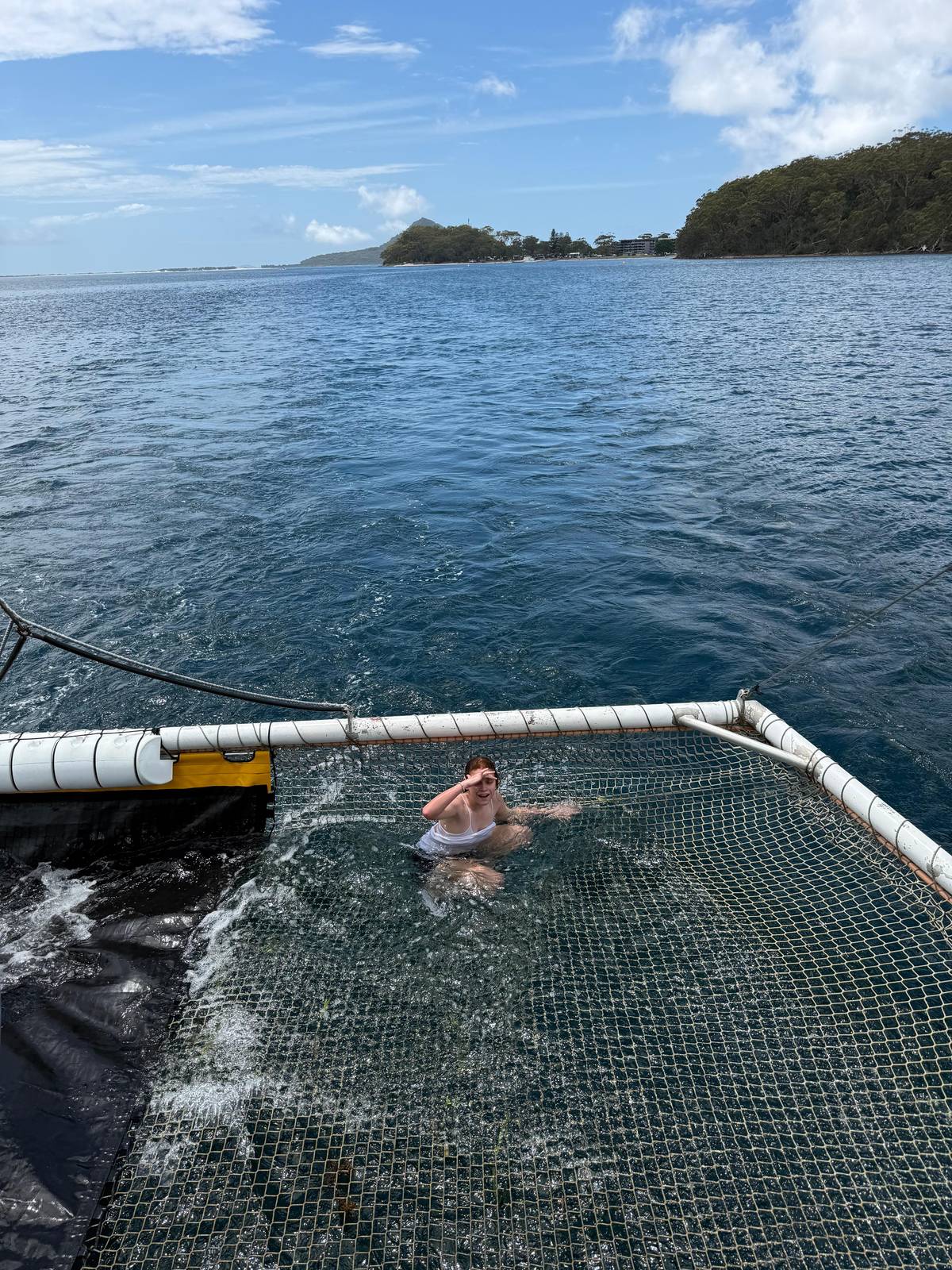
The easiest way to meet the Port Stephens dolphins is a cruise from Nelson Bay. The one this site recommends lasts 1.5 hours, includes a turn in the boom net, and starts from $33, rated 4.41 from 1,002 reviews. Its operator states plainly that dolphins are wild and sightings cannot be guaranteed.
Smaller boats are an alternative. A sailing catamaran spends 1.5 hours dolphin watching from the d'Albora marina, from $35 and rated 4.77 from 105 reviews. An express boat does the trip in 1 hour from $39, rated 4.94 from 60 reviews.
You can also try from land. Zenith Beach is a sanctuary zone of the marine park where National Parks says you can see dolphins and birdlife, and Destination Port Stephens points to Birubi Point at Anna Bay for dolphins all year.1819 Bring binoculars, pick a calm morning and scan for the curve of a back rather than a splash. On the boat itself, stand where you can see both sides rather than crowding the rail where the first fin appeared; dolphins often surface again away from the spot everyone is watching.
Meet the locals
Fins in the bay, a splash in the net
1.5 hours from Wharf 1, Nelson Bay, boom net included; cancel free until a day before.


You ask,we answer.
How many dolphins live in Port Stephens?
Around 90 to 120. The NSW Government's figure for the resident Indo-Pacific bottlenose dolphins.1
What species are the Port Stephens dolphins?
Indo-Pacific bottlenose dolphins. A small, genetically distinct population.2
Can I see dolphins in winter?
Yes. Cruises leave Nelson Bay all year round.3
How close can a boat go to a dolphin?
50 metres. Inside 150 metres the boat is in the caution zone.4
Can I swim with the dolphins?
Only at a distance. Swimmers must stay at least 30 metres from a dolphin.5
Is it OK to feed a dolphin?
No. Feeding dolphins is harmful and illegal in NSW.6
How do researchers recognise each dolphin?
By the dorsal fin. Each fin has its own shape, notches and scars.16
Sources
Evidence for this guide
- 1NSW Department of Climate Change, Energy, the Environment and Water (Environment and Heritage)Port Stephens Bottlenose Dolphins: Visitor guide↩
- 2Macquarie University research portal (abstract of Steckenreuter, Möller & Harcourt 2012, Journal of Environmental Management 97: 14-21)How does Australia's largest dolphin-watching industry affect the behaviour of a small and resident population of Indo-Pacific bottlenose dolphins?↩
- 3Destination NSW (Visit NSW)Nelson Bay, Port Stephens↩
- 4NSW Department of Climate Change, Energy, the Environment and Water (Environment and Heritage)Approach distances for whales, dolphins and dugongs↩
- 5NSW Department of Climate Change, Energy, the Environment and Water (Environment and Heritage)Approach distances for whales, dolphins and dugongs↩
- 6NSW Department of Climate Change, Energy, the Environment and Water (Environment and Heritage)Bottlenose dolphin | Native animals↩
- 7Macquarie University research portal (abstract of Wiszniewski, Beheregaray, Allen & Möller 2010, Conservation Genetics 11: 1405-1419)Environmental and social influences on the genetic structure of bottlenose dolphins (Tursiops aduncus) in Southeastern Australia↩
- 8NSW Department of Climate Change, Energy, the Environment and Water (Environment and Heritage)Port Stephens Bottlenose Dolphins: Visitor guide↩
- 9NSW Department of Climate Change, Energy, the Environment and Water (Environment and Heritage)Bottlenose dolphin | Native animals↩
- 10NSW Department of Climate Change, Energy, the Environment and Water (Environment and Heritage)Bottlenose dolphin | Native animals↩
- 11Australian MuseumBottlenose Dolphin (Tursiops truncatus)↩
- 12NSW Department of Climate Change, Energy, the Environment and Water (Environment and Heritage)Port Stephens (Health of our estuaries)↩
- 13NSW Department of Climate Change, Energy, the Environment and Water (Environment and Heritage)Port Stephens (Health of our estuaries)↩
- 14Macquarie University research portal (abstract of Wiszniewski, Allen & Möller 2009, Animal Behaviour 77: 1449-1457)Social cohesion in a hierarchically structured embayment population of Indo-Pacific bottlenose dolphins↩
- 15Macquarie University research portal (abstract of Wiszniewski, Allen & Möller 2009, Animal Behaviour 77: 1449-1457)Social cohesion in a hierarchically structured embayment population of Indo-Pacific bottlenose dolphins↩
- 16NSW Department of Climate Change, Energy, the Environment and Water (Environment and Heritage)Bottlenose dolphin | Native animals↩
- 17Macquarie University research portal (abstract of Steckenreuter, Möller & Harcourt 2012, Journal of Environmental Management 97: 14-21)How does Australia's largest dolphin-watching industry affect the behaviour of a small and resident population of Indo-Pacific bottlenose dolphins?↩
- 18NSW National Parks and Wildlife ServiceZenith Beach↩
- 19Destination Port Stephens (official visitor site)Anna Bay↩
- 20Macquarie University research portal (abstract of Steckenreuter, Möller & Harcourt 2012, Journal of Environmental Management 97: 14-21)How does Australia's largest dolphin-watching industry affect the behaviour of a small and resident population of Indo-Pacific bottlenose dolphins?↩
- 21Macquarie University research portal (abstract of Steckenreuter, Möller & Harcourt 2012, Journal of Environmental Management 97: 14-21)How does Australia's largest dolphin-watching industry affect the behaviour of a small and resident population of Indo-Pacific bottlenose dolphins?↩
- 22Macquarie University research portal (abstract of Steckenreuter, Möller & Harcourt 2012, Journal of Environmental Management 97: 14-21)How does Australia's largest dolphin-watching industry affect the behaviour of a small and resident population of Indo-Pacific bottlenose dolphins?↩
- 23NSW Department of Climate Change, Energy, the Environment and Water (Environment and Heritage)Approach distances for whales, dolphins and dugongs↩
- 24NSW Department of Climate Change, Energy, the Environment and Water (Environment and Heritage)Approach distances for whales, dolphins and dugongs↩
- 25NSW Department of Climate Change, Energy, the Environment and Water (Environment and Heritage)Approach distances for whales, dolphins and dugongs↩
- 26NSW Department of Climate Change, Energy, the Environment and Water (Environment and Heritage)Approach distances for whales, dolphins and dugongs↩
- 27NSW Department of Climate Change, Energy, the Environment and Water (Environment and Heritage)Bottlenose dolphin | Native animals↩
- 28NSW Department of Climate Change, Energy, the Environment and Water (Environment and Heritage)Approaching marine mammals in New South Wales↩
- 29↩
- 30NSW National Parks and Wildlife ServiceWhale facts↩
Keep reading